THE FAKERS’ SOCIETY HAS A RIOT IN ART
The Society of American Fakers, who in private life are the members of the Art Students’ League of New York, will open their twentieth anniversary celebration this afternoon at 215 West Fifty-seventh Street in the form of a mild riot, which, with an exhibition, a vaudeville bill, and a series of side shows, is to end on Friday evening with a crash in the form of a costume ball. Last night was a sort of artists’ night, when the privileged few were admitted to witness the final preparations, conducted amid hoarsely shouted directions, much hammering, and gales of laughter.
[…] Sidney Dickinson carried off first prize with “New York vs. Milwaukee,” with a fairly close parody of the original enhanced by two giant hands, one holding a glass and the other a bottle of beer—ever so symbolical, the students said last night.
The New York Times, New York, New York, , p. 12.
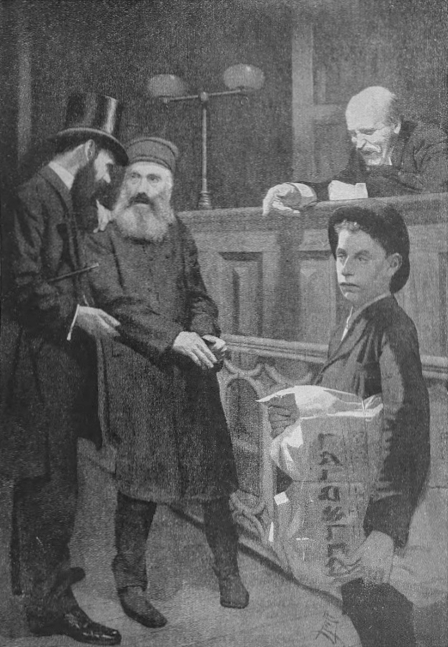
Bruno Lessing’s story in the January number of the Cosmopolitan is illustrated by Sidney E. Dickinson, a younger brother of Thorn Dickinson, civil engineer in the office of the state engineer. Sidney Dickinson was a Fargo boy, educated in the schools there, and a graduate of Oberlin college, but now making a remarkable success in his art work in New York city.
The Bismarck Tribune, , p. 4.
The Cosmopolitan, vol. 52 (Dec. 1911–May 1912), p. 185.
The Winter Academy. (by the Second Viewer.)
Of the portraits, one alone has the distinction of really profound personal feeling, and that is the work of a hitherto unknown man, a Massachusetts painter—Sidney E. Dickinson. Not even Mr. Weir’s own contribution, honestly sincere as it is, gives one a more poignant thrill as a transcript of human nature. Hats off to Mr. Dickinson—whoever he may be. His tone has a slight reminiscence of some of the most sulphurous canvases of Franz Hals, but for all that his portrait is so rarely simple, so decorative, so characterized as to line, that one feels it might have had the centre of the wall to get its due.
American Art News, vol. 14, no. 13, , p. 1.
Successful Painting by Son of Rev. C. H. Dickinson.
A portrait by Mr. Sidney Edward Dickinson, formerly of Middlebury, son of Dr. Charles H. Dickinson, is now on exhibition at the National Academy, New York, the principal exhibition of the paintings of the year. Young Mr. Dickinson’s picture—he is only 25—is regarded by artists and critics as already entitling him to a prominent place among American painters. The New York Herald says, “There are other works of great merit and perhaps the best is the ‘Portrait of the Artist’ by Sidney E. Dickinson, a painter hitherto unknown to fame. It is a subjective work and one feels that the artist was painting his own mind as well as his facial lineaments. The portrait is altogether unforgettable.” Several criticisms speak of the portrait’s having much of the Velasquez in spirit and method. It is hung with a few of the other notable pictures of the year in a place of honor, the Vanderbilt room.
Middlebury Register, , p. 2.
Salmagundi Club Has Retrospective Exhibition.
The “fakirs” of the Salmagundi, as well as every visitor to the club rooms, have been having a lot of fun in their “retrospective exhibition.” There were about one hundred “fakes,” eighty-eight of them the property of Samuel T. Shaw, head of the “fakirs.” Some of the artists are seen to have “faked” their own work. Two prizes of $25 each were awarded, honors being equally divided between Samuel Woolf, for his grotesque picture of Israel Zangwill, and Sidney Dickinson for his “New York versus Milwaukee.”
Brooklyn Eagle, , p. 77.
Spring Exhibition—National Academy of Design
The first Hallgarten prize, as already mentioned, went to Howard E. Smith for his portrait of Bela Pratt; the second to John Follinsbee for a winter landscape; and the third to Sidney Dickinson for a painting entitled “Unrest.”
The American Magazine of Art, vol. 8, no. 7, , p. 273.
“Eclectics” Annual Show
Sidney Dickinson sends a new composition, an exhibition picture which seems destined to make a sensation as it goes the rounds of the large shows. This oblong canvas upon which is represented against a drab background of staircase, heightened with a hanging of crimson, a black haired lady of pallid complexion, whose delicate hands gather tightly about her the folds of a black satin mantle. Mr. Dickinson also contributes his “Young Painter,” a portrait skilfully brushed and high expression of character.
American Art News, vol. 17, no. 9, , p. 2.
Sidney E. Dickinson is engaged in teaching in Minnesota but has found time to paint a large fine new composition which he calls “The Spanish Girl,” on view with the Eclectic group at the Babcock Gallery.
American Art News, vol. 17, no. 10, , p. 4.
Sidney E. Dickinson, who recently returned from Minneapolis, is now engaged upon a portrait of the painter, Arnold Mountfort.
American Art News, vol. 17, no. 17, , p. 6.
Sidney Dickinson, who spent some years teaching in the Minneapolis art school, has returned to N. Y. to make it his permanent home. The work of this able painter has received so much praise from artists and critics within the past few years, that he doubtless will find a warm welcome in all art circles.
American Art News, vol. 17, no. 23, , p. 9.
Spring Academy Seen In Brooklyn
The general opinion of the works of art was that of rapturous approval; but then the atmosphere of private views usually is rapturous. The bright light that has already been referred to proved almost too revealing in the care of two nudes submitted by an artist named Sidney Dickinson. The only discord in the harmony of the occasion was the discomfiture of some of the guests, possibly from Brooklyn, who would have preferred not to have seen these nudes. One of the jury hovered near the objectionable canvases, saying in nervously audible tones: “I did all I could to prevent their getting in, but they would have them.”
The Sun and the New York Herald, , p. 11.
A Tariff on Art: An American Artist Who Wishes Protection
To the Editor of The New York Times.
The New York Times, .
New German Art In Many Phases Shown Here
The impression that carries away from Sidney E. Dickinson’s exhibition at the Milch Galleries, No. 108 West Fifty-seventh street, is that here is a young painter who not only has obtained some markedly interesting results but gives every promise of doing startling things before long. Mr. Dickinson has confined himself to figure painting, which is difficult and therefore shows courage. He is rarely a painter of mood, by which some sway the emotions of the beholder and so gain a reputation. He is cool and calm, always the thinker, considering carefully and painting deliberately. He is sensitive to an exceptional degree, and this is especially evident in his drawing, which remains both subtle and definite. For subjects he has a wide range, although men seem to be his favorites. There is a striking self portrait that attracted a great deal of attention at the National Academy last Spring. This, in its mastery of detail, exemplifies an exactitude which this age with its hasty methods needs to take into account.
Dickinson has visited frequently in Alabama and has painted octoroon types in three pictures that stand out as his great achievement and form a real contribution to modern American art. There is also “The Beggar,” a figure which stands limply, relaxed, half slouching, yet quite alert. For painting of textures Mr. Dickinson has a great love and a great skill. The fur coat of a golden-haired subject and the velvet that is drawn across the background in the portrait of his parents make an appeal to the tactile senses that rarely emanates from pigment. This exhibition will last through October 20.
New York American, , p. 76.
AWARDS OF THE CAROL H. BECK GOLD MEDAL.
1924. Sidney E. Dickinson.
AWARDS OF THE PHILADELPHIA PRIZE
1923. Sidney E. Dickinson.
Catalogue of the One-Hundred-and-Nineteenth Annual Exhibition of the Pennsylvania Academy of the Fine Arts, February 3, 1924–March 23, 1924, , p. 12.
Allied Show Is Its Best
Sidney E. Dickinson shows a superb piece of still life painting in his whimsically entitled “Three Dimensions Only,” which is probably a subtle “slam” at bunk modern art.
New York American, , p. 98.
Not Worth While
There is this drive to do the job well. To relinquish our desperate clinging to the truth for a temporal mannerism is to forego the mystery of self-expression.—Sidney E. Dickinson.
Daily Freeman, , p. 4.
H. L. Hildebrandt who exhibits the painting “Portrait, Valerie M. Hoinoky” is seen in a portrait by Sidney Dickinson.
The Des Moines Register, , p. 18.
American Art
To the Editor of The New York Times.
The New York Times, .
Dickinson Shows Non-Routine Portraits
AFTER AN ABSENCE of several years from the ranks of one-man exhibitors, Sidney Dickinson is back, a selection of his vigorously painted figure pieces being the feature presentation, until Feb. 17, at the Gotham Hotel quarters of the Grand Central Art Galleries. His canvases marked with the imprint of a swift, disciplined brush, range from a small head study, Dancer, to a huge, vividly colored composition, Nude. Also present is his striking portrait, The Pretty Book, which was reproduced in the April 1, 1933, issue of The Art Digest when it won the Maynard Portrait Prize at the National Academy.
New York critics found favor in the Dickinson works. “He paints,” wrote Melville Upton in the Sun, “with tenderness, or dash and decision, as the occasion demands, and without previously knowing the sitters one carries away the impression that he knows them now.”
The Art Digest, vol. 14, no. 10, , p. 14.
The Favorite
[…] has been added to the long list of Popular Prize winners at Carnegie Institute. […] and the informal portrait study, Our Son, Thorn, by Sidney E. Dickinson was third.
Carnegie Magazine, vol. 24, no. 1, , p. 190.

